Conservatory of Flowers The Campaign to Restore the Conservatory of Flowers
Home
Visit Us
Visit Us
Plants
Whats New
Make A Gift
Tours and Event Rentals
Education
History and Photos
Press
Education

Guides Corner

THE AQUATIC PLANTS GALLERY
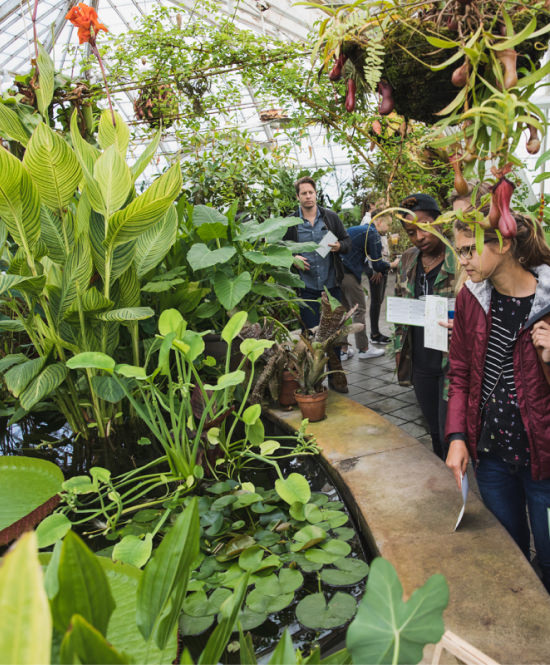
Continuing east, visitors enter the magical world of Aquatic Plants. Beautiful pools of warm water cascade one into the other filling the gallery with the sound of rushing water. A giant art glass and art metal Amazon water lily sculpture hangs suspended in the air, the fine architecture of its leaf glowing in the light.

ARCHITECTURE/DESIGN/ARTWORK

  • In this gallery the visitor will find an art glass and art metal Amazon water lily sculpture, a sculpted strangler fig laden with epiphytes, aerial root planters dripping with bromeliads, aroids and orchids in an ipé wood case.
  • The suspended water lily sculpture allows visitors to see the bottom of a giant Victoria amazonica plant with its impressive structure. This species of water lily influenced Joseph Paxton's design of the entrance to the Crystal Palace built in London in 1851.
  • The piece has been created by glass/metal artist Steven Hirt. The large water lily pad is made of three layers of kiln-formed glass (green, white and magenta) and an elaborate network of cast bronze veins. The flowers are hand-blown glass supported with cast bronze stems. Each petal was individually made, then torch fused to form the flower.
  • The bronze aerial root planters were created by local artist Eric Powell and rise up out of the pools to support bromeliads, aroids and vining plants. The bronze water lily ornamentations for the water jets are also Powell's pieces. Dave Tuthill crafted the elegant, iron-forged art metal railings with the water lily flower bud motif.
  • The upper pool holds 9,000 gallons of water and the lower pool 4,500 gallons. The two pools appear to be circulating the same water, but they are actually separate and maintained at two different temperatures to properly simulate two different environs, lowlands and highlands, and accommodate a wider array of plants.
  • Master stone mason Edwin Hamilton built the stone veneer around the upper and mini pool walls. The veneer is constructed of colorful Mariposa slate, quarried from the Yosemite Valley region.
  • The water in the upper pond is circulated through a coarse, in-line basket filter, a cartridge filter, biofilter, water heater, and UV chamber before being returned to the pool. The same process occurs in the lower pond without the cartridge filter. The water in both pools is seeded with beneficial bacteria and a liquid bacterial solution to combat algae.

GEOGRAPHY/CLIMATE/COUNTRIES
This gallery features plants from the rivers, lakes, estuaries and bogs of the lowland tropics. Countries represented include: Borneo, Brazil, Ecuador, Costa Rica and India.

PLANTS

Amazon water lily, Victoria amazonica Nymphaeaceae

  • Brazil
  • The Victoria amazonica made its North American public flowering debut at the Conservatory in the 1880s. They are native to estuaries of the Amazon River where there is little disturbance or traffic.
  • Amazon water lily leaves range from four to eight feet in diameter (generally not much more than six feet in diameter); they have characteristic upturned edges; the underside of the pad has a system of strong hollow veins, which support the large pads and can hold large amounts of weight such as nesting birds. Sharp thorns cover everything except the flower petals and the tops of the pads to prevent herbivory by manatees and other aquatic life.
  • Flowers range between 10-16 inches in diameter and bloom for two days. On the first night, the flower unfurls and scarab beetles are drawn to its pineapple scent and pure white color. They are also drawn to its warmth. The inside of the flower can be a cozy 98° while the air temperature is 80º. Later that night, the flower cools, closes, and the beetles are trapped inside. On the second day, the flower changes color from white to pink.
  • The flower reopens the following evening, the anthers release their pollen and the beetles fly off covered with pollen.
  • The Victoria has "perfect bisexual flowers," each flower contains both female and male sexual organs. On the first night when the flower opens (cream color) its female organs are receptive while on the second night (pink to reddish color) its male organs are mature. The flower produces special starches and sugars solely for the scarab beetle to eat, and they surround the receptive female stigma (there are several beetles that pollinate the flowers - typical among them are Cyclocephalus hardyi, Cyclocephalus verticalis, Ligyrus sp. and Castanae sp.).
  • The Conservatory's water lily collection also includes: Victoria cruziana from Northern Argentina, Paraguay and Bolivia where the Amazon waters are cooler and the V. 'Longwood Hybrid' first produced by Longwood Gardens in Pennsylvania.
Sacred lotus, Nelumbo nucifera, Nelumbonaceae
  • Asia and Northeast Australi
  • The lovely flowers of the lotus provide food for the soul just as its starchy rhizomes provide food for the body.
  • They typically grow from three to five feet with flowers forming nine to 12 inches across. Lotuses are day bloomers usually opening early in the morning and closing by midafternoon for three successive days. The center of the flower is a disk-shaped "cone" that holds the pistils and subsequently the seeds.
  • Once the flower is spent, the "cone" gradually changes color, turning from green to a light tawny brown. Ovules that are fertilized become enlarged and black, while those that did not get fertilized shrivel in the cone. If some of the seeds are fertile, the entire cone will tilt to the water so the seed will fall out into the water.
  • This species is intimately linked with the Buddhist religion, symbolizing perpetual life, purity and beauty. The Buddha is said to have arose from the heart of a lotus bud out of the murky waters. In Buddhist painting and sculpture, the Buddha is typically shown delivering an important sermon sitting on a lotus pedestal.
  • The sacred lotus is the National Flower of India. Hindus believe that Brahma, creator and god of the universe, sprang from a lotus blossom. It is said the lotus first bloomed with the creation of the universe.
  • The flower of the sacred lotus was immortalized in Homer's The Odyssey, in which Ulysses and his crew come ashore on the Island of the Lotus-Eaters. Nelumbo nucifera was often smoked or made into a tea with the idea that it would create a feeling of euphoria.
  • A 1,288 year-old seed of this species collected from an ancient lakebed in China is one of the oldest germinable seeds on record.
  • Along with its ornamental value, this plant is cultivated for food and traditional Chinese medicine. Virtually all parts of the plant can be eaten. In China and Taiwan, lotus rhizomes are a dietary staple. The leaves are also eaten and used to wrap foods for baking and steaming.
  • All parts of the sacred lotus are used for their astringent, cardiotonic, febrifuge, hypotensive, resolvent, stomachic, styptic, tonic and vasodilator, cancer and miscellany healing properties. Lotus flowers, pods, or petals are most commonly used, while the flower stamens are reported to be the most potent part of the plant.
Water poppy, Hydrocleys nymphoides, Limnocharitaceae
  • Brazil; introduced to Texas and Florida
  • This plant blooms when the water temperature reaches 70-75°F.
  • It prefers to grow in 4-12 inches of water but will grow in water up to 3 feet deep.
Water lily, Nymphaea spp, Nymphaeaceae
  • These aquatic plants are cosmopolitan in distribution.
  • The Nymphaeaceae contains our native waterlily, Nuphar lutea.
  • The large, scented flowers are pollinated by bees, syrphid flies, and beetles.
  • Some species have been used as narcotics in various cultures through the years (Mayans, ancient Egyptians).
  • Nymphaeas were used to make the wreaths found on the mummy of Ramses II dating back to 2000BC.
Velvet leaf, Limnocharis flava, Alismataceae
  • Native to American continent, but introduced to SE Asia and Australia.
  • Young leaves are cooked and eaten in Vietnam and Bangladesh, used as fodder for cattle and pigs in Sumatra, and as a green manure for fertilizing rice paddies.
CARNIVOROUS PLANTS
The Aquatic Plants gallery also displays the Conservatory's collection of carnivorous plants, most notably the Nepenthes spp. commonly known as Asian pitcher plants.

Asian pitcher plants, Nepenthes spp., Nepenthaceae
  • Southeast Asia and Madagascar. The majority are found in Borneo.
  • Though we feature the lowland species, 70% of Nepenthes species are found in the highlands at elevations of 3,000 to 10,000 feet above sea level.
  • Carl Linnaeus named them Nepenthes recalling Homer's Odyssey and the drug "Nepenthe" that Helen of Try poured into the soldier's wine to alleviate their sorrow and grief. Linnaeus felt the Nepenthes had a similar affect on botanists.
  • The Asian pitcher plant family is the only group of carnivorous plants that grows as a vine, the vines can grow to 20-30 feet long.
  • Extrafloral nectaries on the pitchers and leaves attract insects, once inside the waxy tube, the prey slides into the base of the pitcher where a pool of enzymes awaits to decompose the victim.
  • They generally "eat" gnats, flies or moths. Rarely, some may capture a bird, frog or small rodent. Aquatic carnivorous plants capture: mosquito larvae, protozoa and daphnia.
  • Carnivorous plants have adapted to living in nutrient-poor environments. To supplement their diet they attract, capture, kill and digest animals; this is how they derive their nutrients.
  • Carnivorous plants are not very different from other plants. For instance, they reproduce in the same manner as other flowering plants.
  • In cultivation carnivorous plants do not respond well to commercially formulated fertilizers.
  • Close to 100 species and subspecies of Nepenthes have been identified.
Rice, Oryza sativa, Poaceae
  • Southeast Asia
  • Rice is extensively cultivated in warm climates where it forms the staple food of 50% of the world's population.
  • A tall-growing grass, rice can reach to six feet tall. In spite of the many different wild species of rice that have existed over the millennia, all the modern cultivated varieties are based on only two species: Oryza glaberrima, an annual red rice species originating in West Africa and Oryza sativa, the original of all Asian rice cultivars.
  • There are two main groupings of Oryza sativa cultivars: swamp rice, the most important, which requires flooding for two to three months during its growth-this is the rice we typically see in "rice paddies," and mountain, or upland rice, which requires less irrigation. Swamp rice grows faster, more vigorously and is considered tastier than the mountain variety.
  • Rice has fed more people over a longer period of time than any other crop. As far back as 2500 B.C. rice has been documented as a source of food. People have used rice to make snacks, desserts, main courses, alcoholic beverages and special foods for religious ceremonies. In classical Chinese, the same term refers to both "rice" and "agriculture." In many official languages and local dialects the verb "to eat" means "to eat rice."
  • To prepare rice for market, the rough rice undergoes several processes: cleaning, parboiling, hulling, pearling, polishing and grading.
  • The cleaning process removes all extraneous matter, such as "dead" grains, stones and stalks. For certain varieties it is necessary to parboil (steep) the cleaned rice in hot water to remove the hull and to improve the storage life of the grain. This process also improves the thiamine content of the grain.
  • Rice has been used to fight breast cancer, diarrhea, dysentery, dyspepsia, fever, indigestion, inflammation, opthalmia, swelling and others. In parts of China, rice cakes were fried in camel's fat and used to treat hemorrhoids. Rice sprouts are used for poor appetite, dyspepsia, fullness of abdomen and chest, and weak spleen and stomach. Rice is a source of magnesium, thiamin, niacin, phosphorus, vitamin B6, zinc and copper. Some varieties have iron, potassium and folic acid.
  • White rice contains one of the lowest protein contents among cereal grains.
Silver dollar maiden hair fern, Adiantum peruvianum, Pteridaceae
  • Peru, Ecuador and Bolivia
  • A large fern, native to Peru. The new leaflets are oval shaped and displays a pale pink shade, later turning to pale green with a metallic sheen and finally to a dark green, hence the common name silver dollar.
  • Maidenhair ferns belong to the genus Adiantum, which contains about 200 species. Maidenhair ferns are distinctive in appearance, with dark, often black petioles (a fern's stems) and bright green, often delicately cut leaf tissue. Maidenhair ferns generally prefer humus-rich, moist, well-drained sites, ranging from bottomland soils to vertical rock walls. Many species are especially known for growing on rock walls around waterfalls and water seepage areas.
  • The genus name, Adiantum, comes from the Greek, meaning, "not wetting," referring to the fronds' ability to shed water without becoming wet.
  • It is almost a weed in many tropical situations colonizing rocks and the mortar of buildings.
Butterfly ginger, white ginger lily, known as 'awapuhi-ke'oke'o in Hawaii, Hedychium coronarium, Zingiberaceae
  • Southeast Asia
  • The Zingiberaceae also contains edible ginger.
  • On warm evenings from midsummer through autumn, bright white blossoms of butterfly ginger give off a gardenia-like fragrance that attracts moths.
  • A robust perennial herb three to six feet tall, with large rhizomes and one to three inch white, fragrant flowers. In the summer and fall it bears fragrant flowers that resemble butterflies, thus the common name, butterfly ginger. It has also been said to attract butterflies. It is a tough plant, a light freeze will kill it to the ground, but it will come back full force in the spring.
  • The butterfly ginger is native to Eastern India and Myanmar, yet it is grown throughout the tropics. It's the national flower of Cuba. One of the most widely propagated ornamental gingers; its delicious scent makes it a good cut flower. It has become an invasive pest in Hawaii and Jamaica.
  • In Southeast Asia, the white ginger lily is used as a popular remedy to treat cold, headache, arthritis and injuries.
Green taro, poi, Colocasia esculenta, Araceae
  • Tropical Asia
  • Green taro has been cultivated for more than 6,000 years. From Malaysia to Egypt, and almost all tropical parts in between, taro is still an important source of food.
  • Taro is a perennial herb, with clusters of long heart or arrowhead-shaped leaves that point earthward. Taro grows on erect stems that may be green, red, black or variegated. The new leaf and stem push out of the innermost stalk, unrolling as they emerge. The stems are usually several feet high. Tiny new plants appear around the base of the tuber. The inflorescence is an open, yellow-white calla lily-like tube (spathe), enclosing a spike (spadix) covered with flowers.
  • The corm, a short underground stem, stores starch produced by the leaves. In the eight to sixteen months of its development, the tuber can grow as large as six inches in diameter. This valuable starchy tuber was the staple of Pacific Islanders.
  • The Araceae is a large family, comprising some hundred genera and more than fifteen hundred species. Mostly tropical or subtropical plants, the aroids grow mainly in moist or shady habitats. Some are terrestrial plants while others are vines, creepers or climbers. Many species of the Araceae are also epiphytes.
  • The species is thought to be a native of India and perhaps other parts of southern Asia and from there its cultivation has extended. It reached Egypt about 2,000 years ago and spread into the Pacific area in ancient times. However, it was in Hawaii that the cultivation of taro, called kalo, reached its most sophisticated level.
  • In Ancient Hawaii, before 1778, about 300 varieties of taro were grown in Hawaii. In that time, earlier Hawaiians cultivated taro mixed with other species, such as Erythrina spp., banana, papaya, coconut, green peas, which ensure the maintenance of the health of taro species. The 20th century brought the monoculture technique, which made taro very much susceptible to diseases. Now, in the 21st century there are only seven to 12 varieties in the taro family. Ancient taro fields can be seen in the Hanalei Valley, Kaua'i, and the remains of others are found in remote areas, now uninhabited, such as Na Pali Coast of Kaua'i.
  • The fibrous flesh of the tuber is tough and spongy, ranging in color from white, yellow, lilac-purple and pink to reddish. The tubers are eaten baked, boiled or steamed, or cooked and mashed with water to make poi. High gluten content in the tuber is important to make quality poi. Poi is eaten fresh or allowed to ferment for a few days, often for longer, creating a sour taste considered pleasant, but not alcoholic. Grated taro is also steamed or baked with coconut cream to make kulolo, a pudding.
  • The young leaves of taro are rich in vitamin C and contain thiamine (vitamin B1), riboflavin (vitamin B2), niacin, and others.
Strangler Fig
  • The strangler fig is a common name for a number of tropical plants species, most of them from the fig family (Moraceae). The strangler fig begins its life as an epiphyte in the branches of its host tree. The young fig begins to encircle the host tree with the long roots it sends to the ground in search of nutrients.
  • As soon as its roots hit the ground, its growth rate accelerates sending more roots down wrapping themselves around the host tree. Eventually, it suffocates the host tree, which dies and begins to decompose leaving behind a hollow core in the adult strangler fig.
Myrmecodia tuberosa, Rubiaceae
  • Southeast Asia
  • The Rubiaceae also contains gardenias and coffee.
  • This plant is an epiphyte with a swollen stem penetrated by numerous galleries and chambers.
  • Ants live in the tunnels in the swollen base, bringing in decaying matter that nourishes the plant. While out collecting nectar, the ants defend the plant against herbivores. Ants may actually deter pollinators, so the plants mostly self-fertilize. The seeds may germinate on the mother plant or are distributed by birds or ants.
Papyrus, Cyperus papyrus, Cyperaceae
  • North and Tropical Africa
  • Papyrus has been used for food, medicine, fiber and shelter for more than 4,000 years.
  • Papyrus grows at the shore's edge of waterways. It grows in water up to about three feet deep and can reach five to 12 feet in height. Like all sedges, the stems of the Cyperus papyrus plant are triangular in shape which helps to give it the strength to withstand high winds without breaking. Papyrus is native to the lakes and rivers of northern Africa, in particular, the countries of Egypt and Sudan.
  • The ancient Egyptians started making paper from the papyrus plant over five thousand years ago and it became one of Egypt's major exports. The modern word "paper" originates from the word "papyrus." Realizing the value of papyrus, the Pharohs made its production a state monopoly and private production or cultivation was penalized by death.
  • Not only did the Egyptians make paper from papyrus but they also used it to make sandals, wove it into mats, baskets and fencing, made rope and also used parts of the plant for food as well as a medicine. The reeds were bundled together to make boats and dried to make fuel for fires.
  • In the Bible the infant Moses was found among the bulrushes, as Cyperis papyrus is also called.
  • There was no real competitor to papyrus until, in 105 ADs, a Chinese court official called Ts'ai Lun invented paper. With the introduction of paper making into Egypt, the production of papyrus rapidly declined, and eventually stopped. Papyrus was cultivated and used for writing material by Egyptians until the eighth and ninth centuries when paper from other plant fibers were utilized. By the third century AD the less expensive vellum, or parchment, had begun to replace papyrus in Europe.
  • Today the most important uses of papyrus are that of ecological resources. The rhizomes of the plant prevent soil erosion and trap polluted sediments. A study from 1997 showed that papyrus is useful in wastewater treatment. The study showed that papyrus reduced the amount of nitrogen and phosphorus in wastewater by more than fifty percent in seven to eight months.
  • Galen, Dioscorides and later Islamic pharmacologists including Ibn Gulgul and El Ghafiqi, included papyrus among medicinal plants. The main use was confined to burnt papyrus sheets, the ash of which was thought to have the action of pulverized charcoal and used for certain eye diseases. Dioscorides (in 78 AD) writes that its ash checks malignant ulcers from spreading in the mouth or elsewhere. Galen (129-200 AD) says that the plant is not used in a raw state but if macerated in vinegar and burnt, the ash heals wounds. Europeans also list this among their traditional cancer cures.


<< Back to Tours


Have suggestions for other topics? Please contact Lisa Van Cleef @ lisavan@pacbell.net or leave a message for me here. My inbox is on the work table in the kitchen.


Home | Visit Us| Inside Conservatory | Plants | What's New | Make A Gift
Education | Tours and Event Rentals | History & Photos | Press